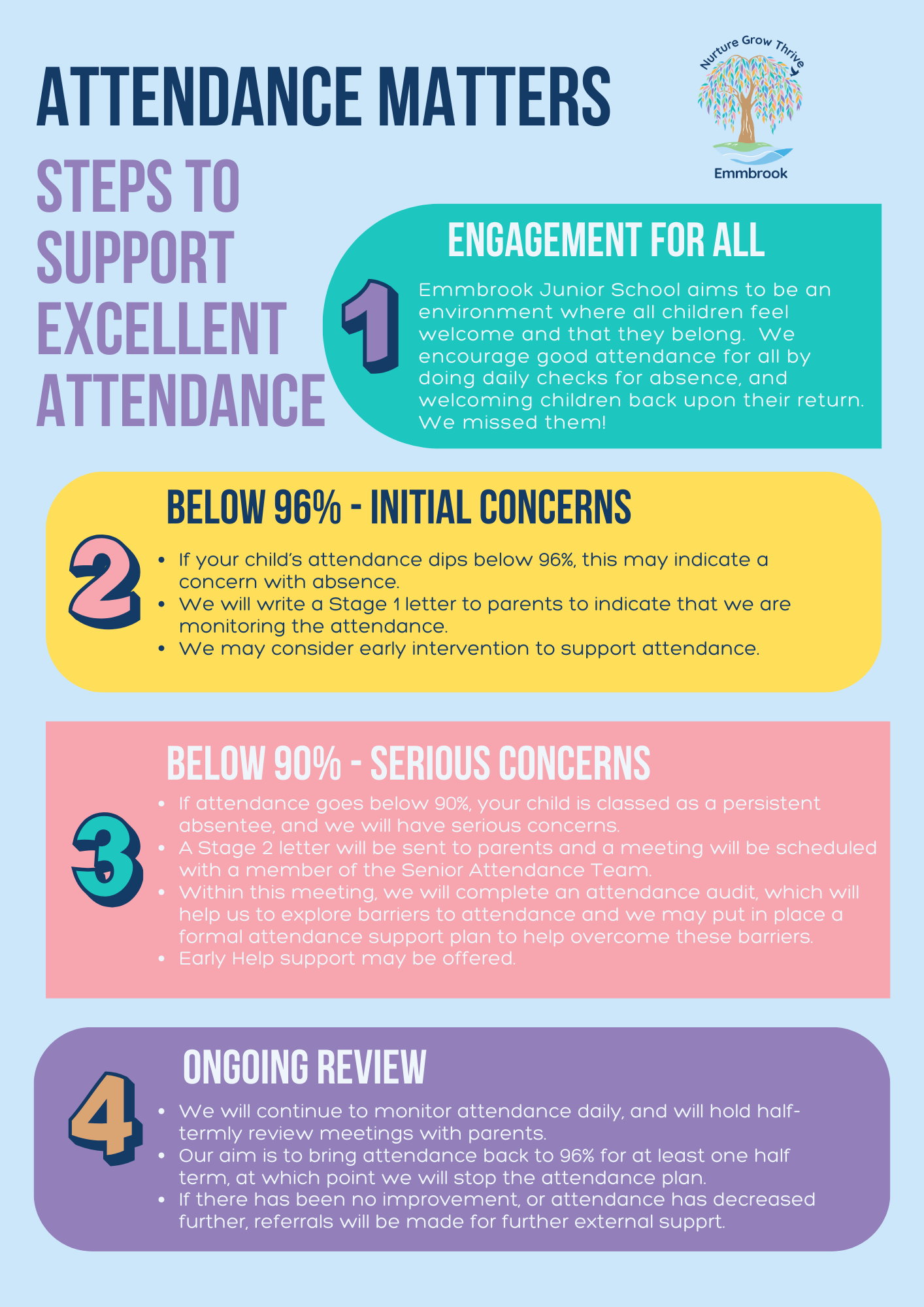
Attendance Matters
Regular school attendance enables children to maximise the educational opportunities available to them. Excellent attendance helps children to become emotionally resilient, confident and competent adults who are able to realise their full potential and make a positive contribution to their community; utilising their God-given talents.
Emmbrook Junior School values all children and we strive to crate a nurturing environment for children to feel safe, well and secure in. We work with families to identify the barriers to achieving and maintaining excellent attendance and offer the right services, at the right time, to resolve difficulties. The Senior Leader team monitor attendance weekly and use attendance data to identify any patterns of concern, whilst also celebrating success.
Attendance concerns will be raised with parents (when reasons are not known by the school, e.g. recovery from an operation). This information may also be shared with the Local Authority. Where we have concerns, or there is a lack of engagement from families to improve attendance, we will follow the school’s staged approach to improving attendance.
This staged approach is child-centred and prioritises support and developing strong working relationships with families. We will use the Early Help process to provide support prior to escalation and consider how we can work with families to enable children to access their right to education.
Attendance figures for each child will be reported to parents termly: as part of the Parents’ Evenings and pupils’ Annual Reports. Parents can also access their child’s live attendance figure, at any time, through the Arbor app. These figures will be closely monitored for support.
Our Staged Approach
At Emmbrook Junior School, we implement a staged approach to promote excellent attendance for every pupil. Our staged approach is underpinned by six principles:
1. Expect: a culture where all children can, and want, to be in school.
2. Monitor: analyse attendance data weekly to identify patterns of poor attendance or areas of concern.
3. Listen and Understand: working alongside parents to understand their barriers to attendance; work together to remove them.
4. Facilitate Support: empower parents by supporting them to access external support to overcome barriers outside of school.
5. Formalise Support: this could include formalising support through a Parenting Contract of Education Supervision Order.
6. Enforce: statutory intervention or prosecution to protect the child’s right to an education. This stage will only be implemented when all previous stages of the approach have been exhausted and there is no other option.